EXHIBITION 01 · BITCOIN MUSEUM, EL SALVADOR
Bitcoin in Space
Every key, coin, copy and signal of Bitcoin that has ever left the Earth — from a weather balloon at 34 km to two wallets that are sitting on the Moon right now.
7 CHAPTERS · 5 MIN WITH NARRATION
Research updated: 14 November 2026
START HERE
What actually flies?
A bitcoin cannot be put on a rocket. It is an entry on a ledger kept by thousands of computers. What can fly is a private key, a copy of the data, or a radio signal.
This exhibition follows every documented case, in order of altitude. Scroll to climb. Each stop has an animated reconstruction with narration, the flight data of the rocket that carried it, and the sources — including the blockchain itself, where the evidence is public and permanent.
We have tried to be exact about what is confirmed, what is only claimed, and what is myth. Space history and Bitcoin history both deserve that.
SCROLL TO FLY
CHAPTER 01 · STRATOSPHERE
30 August 2016
The edge of space
34 kmabove Earth

The first Bitcoin object to leave the ground did not reach space. It reached a third of the way there, hanging under a weather balloon over England.
In the late summer of 2016 the cloud-mining company Genesis Mining attached a 3D-printed Bitcoin logo, a paper wallet and a camera to a latex weather balloon. As it climbed, two payments of exactly 1 BTC each were broadcast from the ground to the address printed on the paper. The blockchain shows them confirmed in consecutive blocks, 427,507 and 427,508, less than ten minutes apart, on 30 August 2016.
The company reported a peak altitude of 34 km before the balloon burst and the payload came down by parachute. Both addresses were a wink: a wallet starting with 1Genesis… paid a wallet starting with 1Moon….
The paper key that rode to the stratosphere was used again fifteen months later: on 6 December 2017 it moved 2.009 BTC out of the address, which has been empty ever since.
Honest label34 km is the stratosphere. Space begins at the Kármán line, 100 km up. And no bitcoin left the ground: the coins stayed on the ledger while a key took the ride. The altitudes of the two payments (20 km and 34 km) are the company's own account.
CHAPTER 02 · LOW EARTH ORBIT
5 December 2019 – 27 June 2020
A key on the Space Station
≈420 kmabove Earth



The first Bitcoin transaction co-signed by a key in orbit took about a day and a half to complete. That was the point.
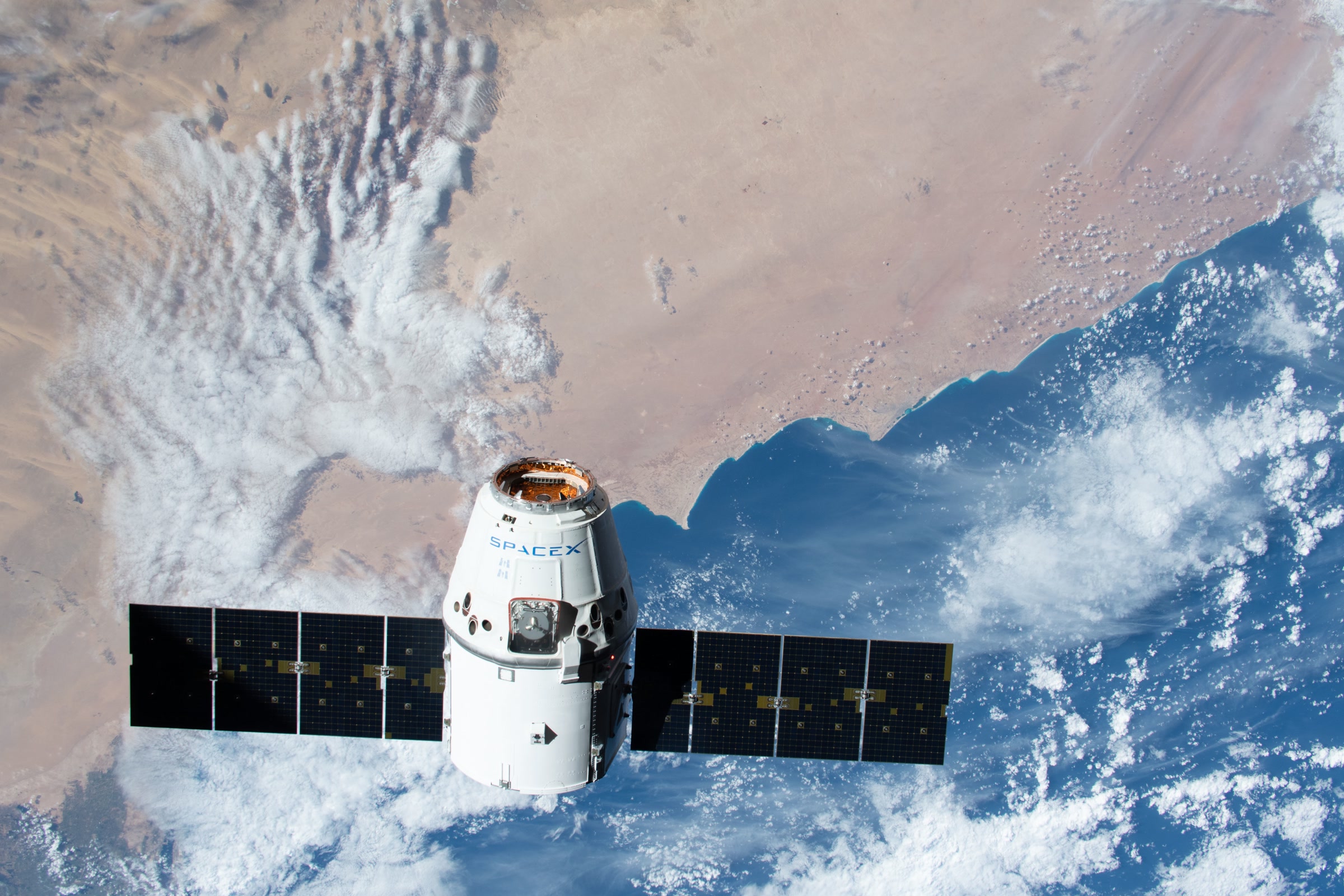
On 5 December 2019 at 17:29:24 UTC, a Falcon 9 lifted off from Space Launch Complex 40 at Cape Canaveral carrying the Dragon cargo ship of mission CRS-19. Among its 2,617 kg of cargo was a small hardware wallet built by SpaceChain, flying a computer from the Danish firm GomSpace and supported by a European Space Agency kick-start grant. Three days later Dragon was berthed to the International Space Station, and the device was later installed on the commercial Nanoracks platform.
The wallet was a 2-of-3 multisignature address: two keys stayed on the ground, the third flew. In June 2020 an unsigned transaction was sent up through a ground station, signed on board, and sent back down. It was confirmed in block 636,529 on 27 June 2020 at 03:42 UTC: 0.00993709 BTC in, 0.001 BTC and 0.00888327 BTC out.
The man who started the transaction, from the ground, was Jeff Garzik, an early Bitcoin Core developer. In 2013 he had proposed BitSat, a fleet of tiny satellites broadcasting the blockchain; a contract for 24 of them was announced in 2015, and none ever flew. Six and a half years after that first idea, a transaction of his was co-signed in orbit.
What the blockchain can and cannot proveThe chain proves a 2-of-3 multisig spend with two valid signatures. It cannot show where a signature was made: that one came from the ISS is SpaceChain's statement, backed by its named partners. No astronaut “sent bitcoin”. What became of the hardware after 2022 is not documented.
CHAPTER 03 · POLAR ORBIT
1 – 4 April 2025
A miner over the poles
≈430 kmabove Earth

No Bitcoin object is known to have flown on Fram2. The mission itself is the exhibit: the first human flight over both poles, bought by a man who started mining bitcoin on a laptop.
Chun Wang discovered Bitcoin in 2011 and co-founded the mining pool F2Pool in 2013. In 2025 he paid for, and commanded, a private SpaceX mission named after the Norwegian polar ship Fram. He has never disclosed the price.
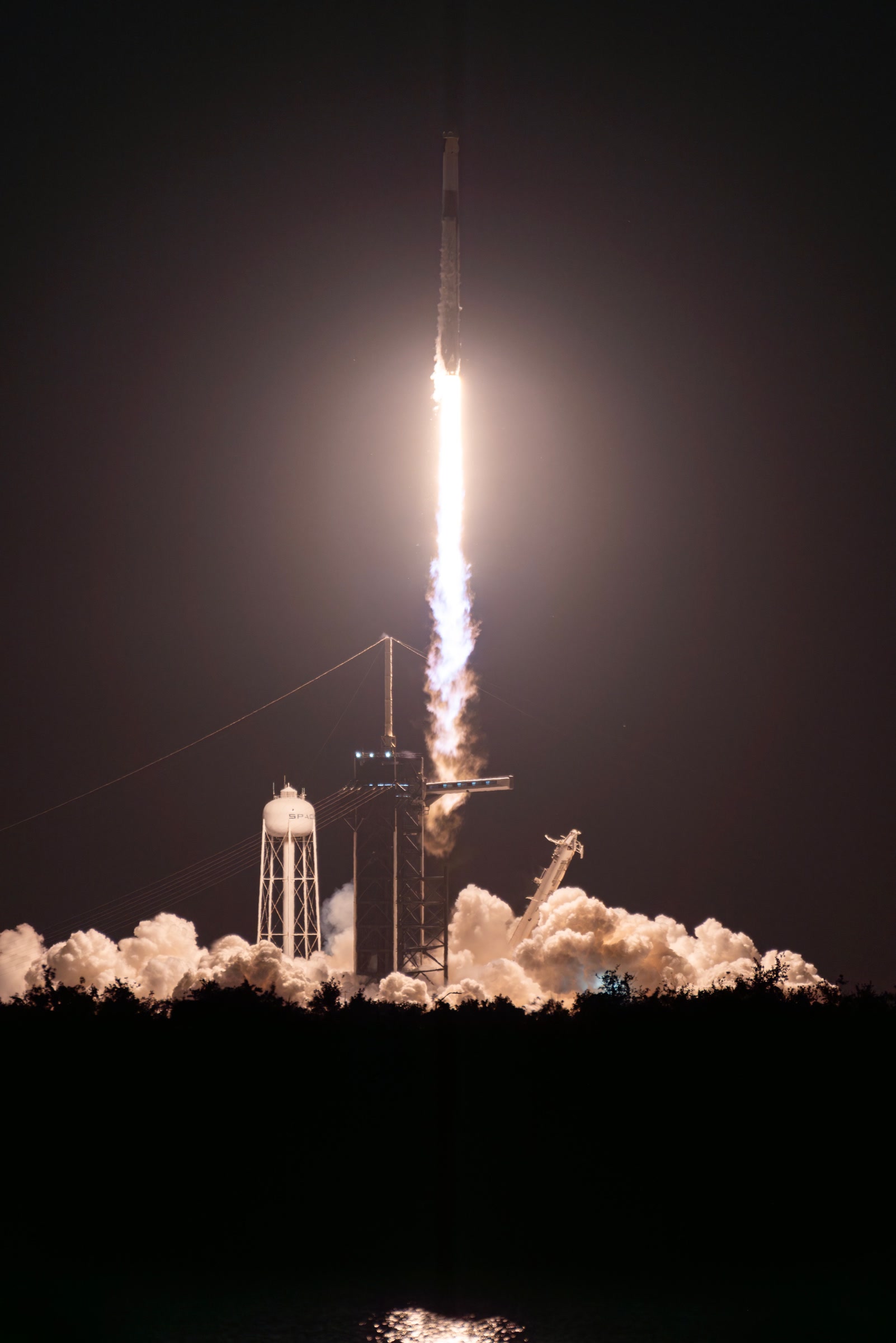
Fram2 lifted off from Pad 39A at Kennedy Space Center — the Apollo 11 pad — on 1 April 2025 at 01:46:50 UTC and flew south, into an orbit inclined 90° to the equator. For 3 days, 14 hours and 32 minutes its four first-time astronauts saw what no crew on the Space Station can: both poles. The previous record for a crewed orbit's inclination, 65°, had stood since Vostok 6 in 1963.
The crew ran 22 experiments, among them the first X-ray of a human in space, and splashed down in the Pacific off California. In May 2026 SpaceX announced that Wang will fly again: around the Moon on Starship, and later on a flyby of Mars. No dates were given.
What we could not confirmThere is no evidence that SpaceX was paid in bitcoin, or that Wang carried a coin, a wallet or the white paper, or signed a transaction in orbit. The press calls him the first known bitcoiner in orbit; keep the word “known”.
CHAPTER 04 · GEOSTATIONARY ORBIT
Since 15 August 2017
The blockchain from the sky
35,786 kmabove Earth

Since August 2017 the whole Bitcoin blockchain has been falling from the sky, free of charge, for anyone with a dish pointed at the right satellite. It still is.
At 35,786 km above the equator a satellite takes exactly one day to circle the Earth, so from the ground it appears to hang motionless. Blockstream does not own any of these satellites. It leases capacity on commercial communications satellites, uplinks every new block from ground stations, and lets the satellites rebroadcast it. Anyone with a small dish and a receiver can keep a Bitcoin node in sync with no internet connection at all.
The service started on 15 August 2017 on Galaxy 18, Eutelsat 113 West A and Telstar 11N; Telstar 18V added Asia-Pacific in December 2018. Version 2.0, in May 2020, switched to the satellite-TV standard DVB-S2 and made it possible to download the entire chain, from the 2009 genesis block, from orbit. A separate API lets anyone pay over Lightning — the minimum bid is one satoshi — to have a message broadcast.
The fleet has a casualty. On 31 January 2024 Eutelsat 113 West A, the relay for South America, suffered an anomaly after eighteen years in orbit and was retired. It now drifts silent, a few hundred kilometers above the geostationary belt. The oldest survivor, Galaxy 18, left Earth in 2008 from a floating platform on the equator in the middle of the Pacific. We checked the service on 14 November 2026: it was transmitting.
One-way streetThe satellite link is a downlink. You cannot send a transaction up to a Blockstream satellite from your dish: messages go to Blockstream over the internet, are paid over Lightning, and only then are uplinked. From 35,786 km the signal takes about 0.12 seconds to arrive.
CHAPTER 05 · CISLUNAR SPACE
8 – 18 January 2024
The coin that missed the Moon
390,000 kmabove Earth




In January 2024 a physical bitcoin flew farther from Earth than the Moon itself — and still missed it. The whole mission was lost to one valve that would not close.
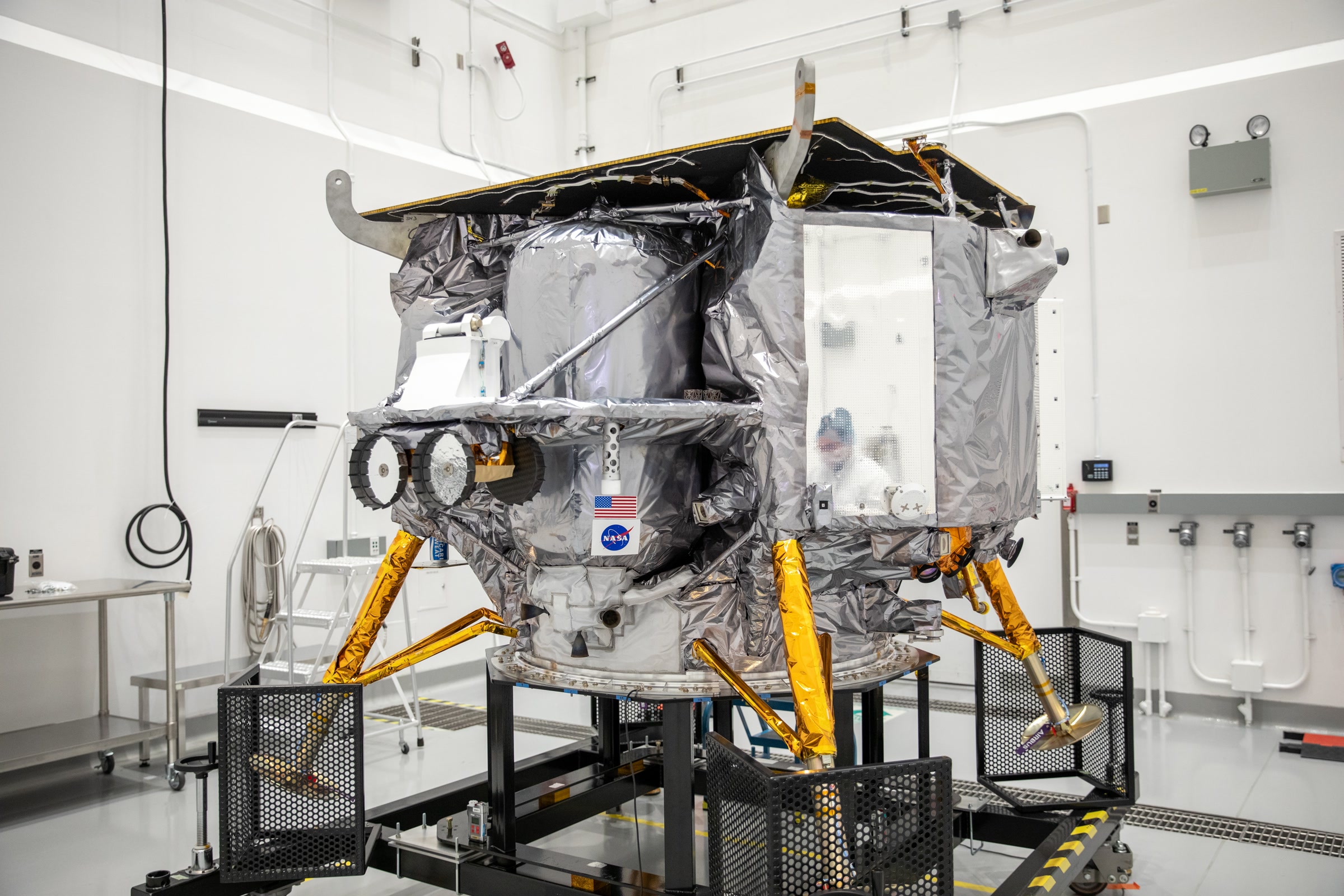
The coin was commissioned by the exchange BitMEX: a one-off physical bitcoin in the tradition of the Casascius coins, with a public address on its face and the private key engraved beneath a tamper-evident hologram. Exactly 1 BTC was loaded onto that address 77 hours before liftoff. Beside it on Astrobotic's Peregrine lander rode a metal plate from Bitcoin Magazine, etched with the raw hexadecimal data of Bitcoin's genesis block.
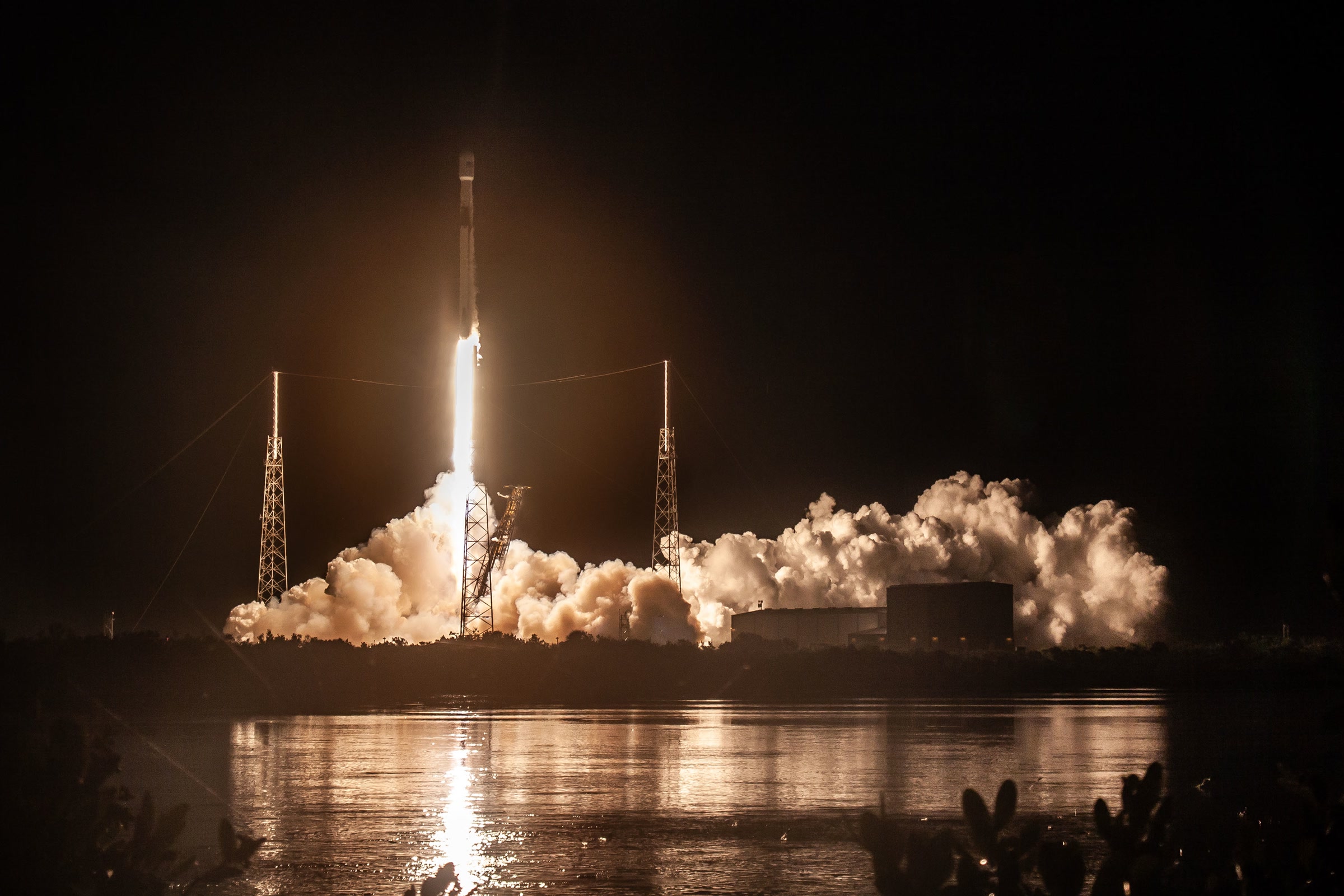
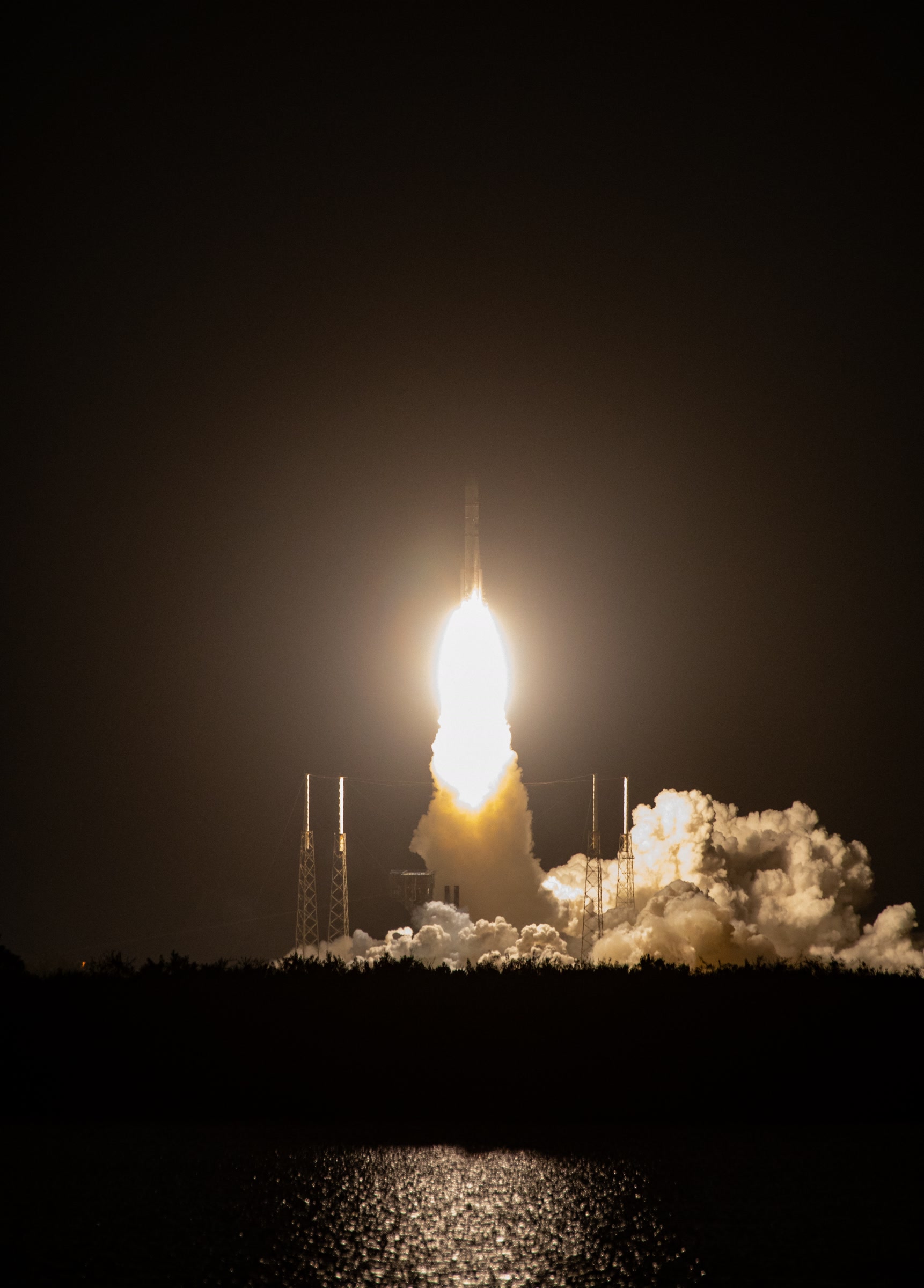
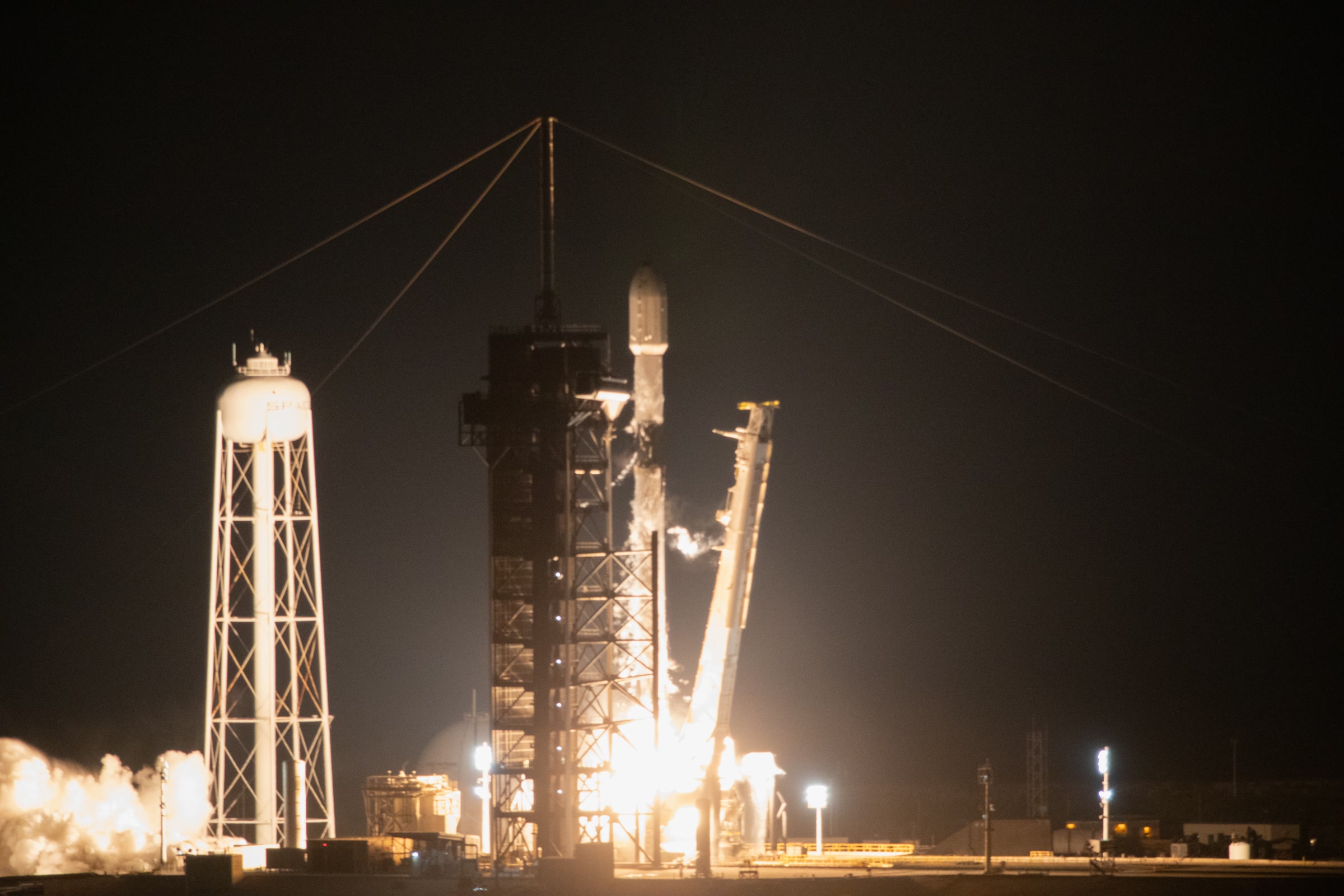
The rocket was brand new. Vulcan Centaur had never flown; neither had its two methane-burning BE-4 engines. It lifted off from Space Launch Complex 41 on 8 January 2024 at 07:18:38 UTC, in the middle of the Florida night, and did its job perfectly: fifty minutes later Peregrine separated on course for the Moon. Then a helium valve failed to reseal, the oxidizer tank ruptured, and the lander began to tumble. With minutes to spare, controllers turned its solar panels back to the Sun. But it was leaking, and it would never land.
Peregrine coasted out to about 390,000 km — beyond the Moon's average distance of 384,400 km — but it was flying a long loop designed to meet the Moon later, and the Moon was not there yet. Astrobotic steered it home instead. On 18 January 2024, around 21:04 UTC, after 10 days and 14 hours and more than 861,000 km, it burned up over the South Pacific, south of Fiji.
Unspent, not provably lostThe address still holds 1.01329989 BTC: the original bitcoin plus small tips from the public. Nothing has ever been spent from it. Whether any copy of the private key survives on Earth has never been stated. The Vulcan upper stage that threw the coin toward the Moon is now in orbit around the Sun.
CHAPTER 06 · LUNAR SURFACE
2 and 6 March 2025
Keys on the Moon
384,400 kmabove Earth






In March 2025, two landers reached the Moon within four days of each other. Each carried the private key to a Bitcoin wallet. Both keys are still there.
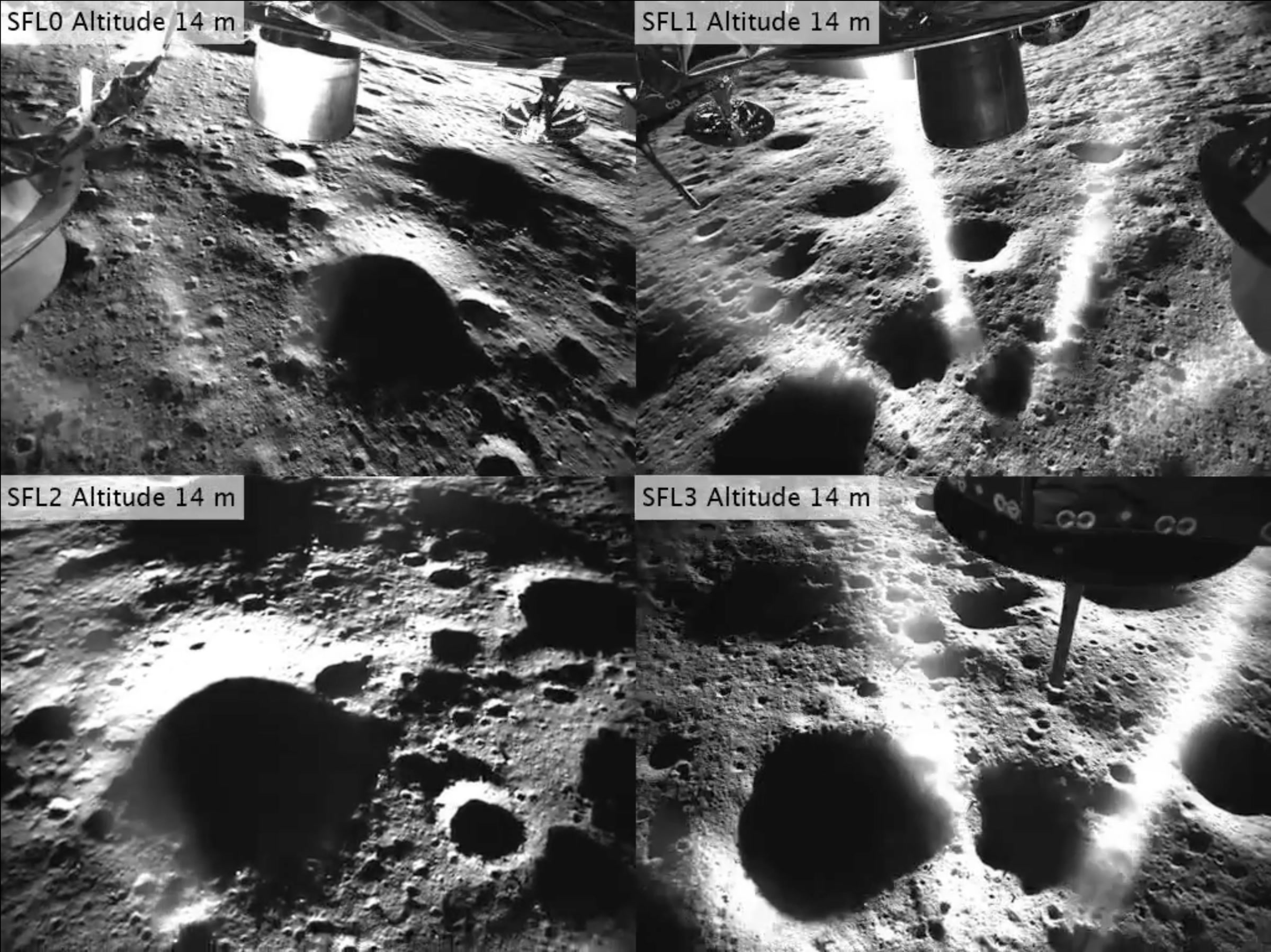
The first arrived on 2 March 2025 at 08:34 UTC, when Firefly Aerospace's Blue Ghost touched down upright in Mare Crisium, the Sea of Crises, after a 45-day journey of about 4.5 million km. On its deck is a golden pyramid small enough to hold in your hand, placed by the company LifeShip. Inside the pyramid, a centimetre-scale device from the start-up Iridia stores wallet keys — Bitcoin among them — in synthetic, DNA-inspired molecules. Iridia published the address after landing. It holds 7,891 satoshis.
The second arrived on 6 March 2025, when Intuitive Machines' lander Athena came down at Mons Mouton, at almost 85° south — the southernmost landing ever — about 250 m from its target, inside a crater, on its side. Its solar panels could not charge, and the mission ended the next day. Strapped to it was Lunar Outpost's MAPP rover, which survived the landing but never rolled out. Laser-engraved on that rover is the key to a wallet called Nakamoto_1, created by the analytics firm LunarCrush as a treasure hunt: whoever reaches the rover can claim it.
Neither wallet is rich. The 2023 headline promised 62 bitcoin for Nakamoto_1; at landing, CNN reported about US$251,000 in mixed crypto-assets, and LunarCrush's chief executive spoke of two bitcoin. And Iridia's wallet, the first on the Moon, is worth a few dollars. The value of both is in where they are.
Which was “first”?The first funded Bitcoin wallet key on the lunar surface is Iridia's (Blue Ghost, 2 March 2025) — though the blockchain shows the same key signing transactions on Earth three days before launch, so a copy existed here. Claims that the Bitcoin white paper was aboard earlier landers come only from their promoters and are not independently confirmed.
CHAPTER 07 · WHAT COMES NEXT
The speed-of-light limit
Beyondnothing yet
Nothing related to Bitcoin has yet travelled beyond the Earth–Moon system. When it does, it will meet the one rule no software update can change: the speed of light.
A radio signal needs 1.28 seconds to reach the Moon. That is 0.2% of Bitcoin's ten-minute block interval: a node on the Moon would keep up with Earth without trouble. On 24 April 2021 five Brazilian radio amateurs made the point in their own way, sending a partially signed Bitcoin transaction as Morse code, bouncing it off the lunar surface and receiving the echo about two and a half seconds later.
Mars is another matter. Depending on where the two planets are in their orbits, a signal takes between about 3 and 22 minutes, one way. At the worst, more than two whole blocks are found on Earth before Mars hears about the first. Mining on Mars against miners on Earth would be hopeless. A 2025 preprint by Jose and Carlos Puente proposes keeping Bitcoin's rules as they are and adding signed “proof-of-transit” timestamps at each relay; it has not been peer-reviewed, and nothing has been tested in space.
Closer to home, the next first may be mining. Starcloud-1, in orbit since November 2025, carries only a graphics processor. Its successor is planned to carry Bitcoin mining chips and has slipped to 2027. As of November 2026, no bitcoin has been mined in orbit.
INTERACTIVE · TO SCALE
Orbit explorer
Low orbit hugs the planet; geostationary orbit is 85 times higher. Drag the globe and slide the zoom to feel the difference. Everything here is drawn to true scale.
Zoom: low orbit ↔ geostationary
Drag to rotate · arrow keys work too
STATUS BOARD · NOVEMBER 2026
Where is it all now?
| Where | What | Bitcoin | Status |
|---|---|---|---|
| 34 km | Genesis Mining paper walletRode a weather balloon; the key was used again in December 2017. | 2 BTC received in flight (2.009 BTC moved out in 2017) | Returned · 2016 |
| ≈420 km | SpaceChain multisig key on the ISSCo-signed one Bitcoin transaction in June 2020. Nothing is documented about the hardware after 2022. | 0.00993709 BTC, spent in the June 2020 transaction | Flown · fate unknown |
| ≈430 km | Fram2 crewFirst crewed polar orbit, commanded by F2Pool co-founder Chun Wang. No Bitcoin object known on board. | — | Returned · 4 Apr 2025 |
| ≈500 km | Bitcoin mining in orbitStarcloud-1 (in orbit) carries only a GPU. Mining chips are planned for Starcloud-2. No bitcoin has been mined in orbit. | — | Planned · 2027 |
| 35,786 km | Blockstream SatelliteLeased capacity on Galaxy 18, Telstar 11N and Telstar 18V. Verified transmitting on 14 November 2026. | — | Broadcasting |
| ≈36,150 km | Eutelsat 113 West AFormer Blockstream relay for South America. Silent since 31 January 2024, drifting above the geostationary belt. | — | Dead · 2024 |
| 390,000 km | BitMEX lunar bitcoin and Genesis PlateFlew past the Moon's distance on Peregrine and re-entered over the South Pacific. 1.0133 BTC remains unspent at the coin's address. | 1.01329989 BTC, still unspent | Burned up · 18 Jan 2024 |
| Moon | Iridia DNA wallet · Blue GhostInside the LifeShip pyramid, on an upright lander. 7,891 satoshis. Landed 2 March 2025. | 0.00007891 BTC (7,891 sats) | Mare Crisium |
| Moon | Nakamoto_1 key · AthenaLaser-engraved on a rover that never left its lander, lying on its side in a crater near the south pole. Landed 6 March 2025. | ≈2 BTC plus other tokens; ≈US$251,000 at landing (press figures, not checked on-chain) | Mons Mouton |
FACT-CHECK
Eight things people get wrong
“Bitcoin has been sent into space.”
FACTBitcoin never leaves the ledger. What has flown are private keys, engraved copies of data, and radio signals. In every case in this exhibition the coins stayed on the blockchain.
“Blockstream launched Bitcoin satellites.”
FACTBlockstream owns no satellites. It leases transponder capacity on commercial geostationary satellites built and launched for television and data.
“An astronaut sent bitcoin from the Space Station.”
FACTThe 2020 transaction was started from the ground by Jeff Garzik and co-signed by hardware on the station. The crew's only role was installing the box.
“There are 62 bitcoin waiting on the Moon.”
FACT62 BTC was a 2023 fundraising target tied to an NFT sale. At landing in March 2025 the Nakamoto_1 wallet was reported at about US$251,000 in mixed crypto-assets, with roughly two bitcoin.
“The Genesis Mining balloon reached space.”
FACTIt reached 34 km, in the stratosphere. Space begins at 100 km. Even the company's chief executive called it “near space”.
“Bitcoin is already being mined in orbit.”
FACTNot as of November 2026. Starcloud-1 carries a graphics processor, not mining chips; those are planned for a later satellite, now expected in 2027.
“The BitMEX bitcoin was destroyed.”
FACTThe physical coin burned up. The bitcoin did not: 1.01329989 BTC still sits, unspent, at 1MoonBTC…. Whether a copy of its private key exists on Earth has never been stated.
“Chun Wang paid SpaceX in bitcoin.”
FACTHe said he paid for Fram2; the price and the means of payment were never disclosed. SpaceX does hold bitcoin of its own: 18,712 BTC, according to its May 2026 S-1 filing.